

 选择城市
选择城市

2019年3月14日雅思阅读会出现哪些题目呢?新东方网雅思频道和大家分享3月14日雅思阅读考前练习。
在2月份的雅思阅读考试中,有2次阅读考试因为难度太大,秒杀众多烤鸭而被送上围脖热搜。整体看来,文章涉及的题型较为综合,且匹配题的考察次数较大,文章话题以自然环境和人文社科为主。下面小编给出类似文章和题目,供大家复习参考(计时每篇20分钟哦):
Passage 1
Renewable Energy
——An insight into the progress in renewable energy research
A The race is on for the ultimate goal of renewable energy: electricity production at prices that are competitive with coal-fired power stations, but without coal’s pollution. Some new technologies are aiming to be the first to push coal from its position as Australia's chief source of electricity.
B At the moment the front-runner in renewable energy is wind technology. According to Peter Bergin of Australian Hydro, one of Australia's leading wind energy companies, there have been no dramatic changes in windmill design for many years, but the cumulative effects of numerous small improvements have had a major impact on cost." We're reaping the benefits of 30 years of research in Europe, without having to make the same mistakes that they did,' Mr. Bergin says.
C Electricity can be produced from coal at around 4 cents per kilowatt-hour, but only if the environmental costs are ignored. 'Australia has the second cheapest electricity in the world ,and this makes it difficult for renewable to compete,' says Richard Hunter of the Australian Eco-generation Association(AEA). Nevertheless, the AEA reports :'The production cost of a kilowatt-hour of wind power is one fifth of what it was 20 years ago, 'or around 7 cents per kilowatt-hour.
D Australian Hydro has dozens of wind monitoring stations across Australia as part of its aim to become Australia's pre-eminent renewable energy company. Despite all these developments, wind power remains one of the few forms of alternative energy where Australia is nowhere near the global cutting edge, mostly just replicating European designs.
E While wind may currently lead the way, some consider a number of technologies under development have more potential. In several cases, Australia is at the forefront of global research in the area Some of them are very site-specific, ensuring that they may never become dominant market players. On the other hand,these newer developments are capable of providing more reliable power, avoiding the major criticism of windmills-the need for back-up on a calm day.
F One such development uses hot ,dry rocks. Deep beneath South Australia, radiation from elements contained in granite heats the rocks. Layers of insulating sedimentation raise the temperatures in some location to 2500 centigrade. An Australian firm, Geo-energy, is proposing to pump water 3.5 kilometres into the earth, where it will travel through tiny fissures in the granite , heating up as it goes until it escapes as steam through another drilled hole.
G No greenhouse gases are produced, but the system needs some additional features if it is to be environmentally friendly. Dr Prue Chopra, a geophysicist at the Australian National University and one of the founders of Geoenergy, note that the steam will bring with it radon gas, along through a heat exchanger and then sent back underground for another cycle. Technically speaking, hot dry rocks are not a renewable source of energy. However, the Australian source is so large it could supply the entire country's needs for thousands of years at current rates of consumption.
H Two other proposals for very different ways to harness sun and wind energy have surfaced recently. Progress continues with Australian company EnviroPower's plans for Australia's first solar chimney near Mildura, in Victoria. Under this scheme, a tall tower will draw hot air from a greenhouse built to cover the surrounding 5 km? As the air rises, it will drive a turbine* to produce electricity. The solar tower combines three very old technologies-the chimney, the turbine and the greenhouse-to produce something quite new. It is this reliance on proven engineering principles that led Enviropower's CEO, Richard Davies, to state: There is no doubt this technology will work, none at all.'
I This year, Enviropower recognized that the quality of sunlight in the Mildura district will require a substantially larger collecting area than was previously thought. However, spokesperson kay Firth says that a new location closer to Mildura will enable Enviropower to balance the increased costs with extra revenue. Besides saving in transmission costs, the new site 'will mean increased revenue from tourism and use of power for telecommunications. We'll also be able to use the outer 500 metres for agribusiness. 'Wind speeds closer to the tower will be too high for farming.
Another Australian company, Wavetech, is achieving success with ways of harvesting the energy in waves. Wavetech's invention uses a curved surface to push waves into a chamber, where the flowing water column pushes air back and forth through a turbine. Wavetech was created when Dr. Tim Devine offered the idea to the world leader in wave generator manufacturers, who rather surprisingly rejected it. Dr. Devine responded by establishing Wavetech, and making a number of other improvements to generator design. Wavetech claims that, at appropriate sites, 'the cost of electricity produced with our technology should be below 4cents per kilowatt-hour.
K The diversity of forms of greenhouse -friendly energy under development in Australia is remarkable. However ,support on a national level is disappointing. According to Richard Hunter of the AEA, 'Australia has huge potential for wind,
sun and wave technology. We should really be at the forefront, but the reality is we are a long way behind.'
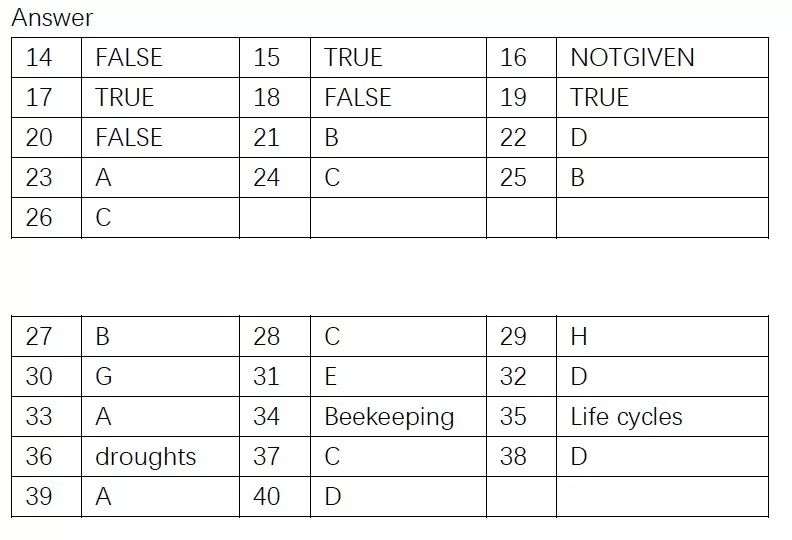
Question 14-20
Do the following statements agree with the information given in Reading Passage 2? In boxes 14-20 on your answer sheet, write
TRUE if the statement agrees with the information
FALSE if the statement contradicts the information
NOT GIVEN if there is no information on this
14. In Australia, alternative energies are less expensive than conventional electricity.
15. Geoenergy needs to adapt its system to make it less harmful to the environment.
16. Dr. Prue Chopra has studied the effects of radon gas on the environment.
17. Hot, dry rocks could provide enough power for the whole of Australia.
18. The new Enviropower facility will keep tourists away.
19. Wavetech was established when its founders were turned down by another company.
20. According to the AEA, Australia is a world leader in developing renewable energy.
Question 21-26
Look at the following statements(Questions 21-26)and the list of companies below.
Match each statement with the correct company, A-D.
Write the correct letter, A-D,in boxes 21-26 on your answer sheet.
NB You may use any letter more than once.
21. During the process, harmful substances are prevented from escaping.
22. Water is used to force air through a special device.
23. Techniques used by other countries are being copied.
24. The system can provide services other than energy production.
25. It is planned to force water deep under the ground.
26. Original estimates for part of the project have been revised.

Passage 2
Amateur Naturalists
A
Tim Sparks slides a small leather-bound notebook out of an envelope. The A book's yellowing pages contain beekeeping notes made between 1941 and 1969 by the late Walter Coates of Kilworth, Leicestershire. He adds it to his growing pile of local journals, bird watchers' lists and gardening diaries ."We're uncovering about one major
new record each month," he says ,"I still get surprised. "Around two centuries before Coates, Robert Marsham, a landowner from Norfolk in the east of England, began recording the life cycles of plants and animals on his estate-
when the first wood anemones flowered, the dates on which the oaks burst into leaf and the rooks began nesting. Successive Marshams continued compiling these notes for 211 years.
B
Today, such records are being put to uses that their authors could not possibly have expected. These data sets, and others like them, are proving invaluable to ecologists interested in the timing of biological events ,or phenology. By combining the records with climate data, researchers can reveal how, for example, changes in temperature affect the arrival of spring, allowing ecologists to make improved predictions about the impact of climate change. A small band of researchers is combing through hundreds of years of records taken by thousands of amateur naturalists. And more systematic projects have also started up, producing anoverwhelming response. "The amount of interest is almost frightening," says Sparks, a climate researcher at the Centre for Ecology and Hydrology in MonksWood, Cambridgeshire.
C
Sparks became aware of the army of "closet phenologists", as he describes them, when a retiring colleague gave him the Marsham records. He now spends much of his time following leads from one historical data set to.As news of his quest spreads, people tip him off to other historical records, and more amateur phenologists come out of their closets. The British devotion to recording and collecting makes his job easier-one man from: Kent sent him 30 years' worth of kitchen calendar ,on which he had noted the date that his neighbour's magnolia tree flowered.
D
Other researchers have unearthed data from equally odd sources. Rafe Sargarin, an ecologist at Stanford University in California, recently studied records of a betting contest in which participants attempt to guess the exact time at which a specially erected wooden tripod will fall through the surface of a thawing river. The competition has taken place annually on the Tenana River in Alaska since 1917, and analysis of the results showed that the thaw now arrives five days earlier than it did when the contest began.
E
Overall, Such records have helped to show that, compared with 20 years ago, a raft of natural events now occur earlier across much of the northern hemisphere, from the opening of leaves to the return of birds from migration and the emergence of butterflies from hibernation. The data can also hint at how nature will change in the future. Together with models of climate change, amateurs' records could help guide conservation. Terry Root, an ecologist at the University of Michigan in Ann Arbor, has collected birdwatchers' counts of wildfowl taken between 1955 and
1996 on seasonal ponds in the American. Midwest and combined them with climate data and models of future warming. Her analysis shows that the increased droughts that the models predict could halve the breeding populations at the ponds. "The number of waterfowl in North America will most probably dropsignificantly with global warming," she says.
F
But not all professionals are happy to use amateur data. "A lot of scientists won't touch them, they say they're too full of problems," says Root. Because different observers can have different ideas of what constitutes, for example, an open snow drop." The biggest concern with ad hoc observations is how carefully and systematically they were taken," says Mark Schwartz of the University of Wisconsin, Milwaukee, who studies the interactions between plants and climate." We need to know pretty precisely what a person's been observing-if they just say 'I noted when the leaves came out',it might not be that useful." Measuring the onset of autumn can be particularly problematic because deciding when leaves change colour is a more subjective process than noting when they appear.
G
Overall, most phenologists are positive about the contribution that amateurs can make." They get at the raw power of science: careful observation of the natural world," says Sagarin. But the professionals also acknowledge the need for careful quality control. Root, for example ,tries to gauge the quality of an amateur archive by interviewing its collector. "You always have to worry things as trivial as vacations can affect measurement. I disregard a lot of records because they're not rigorous enough, "she says. Others suggest that the right statistics can iron out some of the problems with amateur data. Together with colleagues at Wageningen University in the Netherlands, environmental scientist Arnold van Vliet is developing statistical techniques to account for the uncertainty in amateur phenological data. With the enthusiasm of amateur phenologists evident from past records, professional
researchers are now trying to create standardized recording schemes for future efforts. They hope that well-designed studies will generate a volume of observations: large enough to drown out the idiosyncrasies of individual
recorders. The data are cheap to collect, and can provide breadth in space, time and range of species. "It's very difficult to collect data on a large geographical scale without enlisting an army of observers, "says Root.
H
Phenology also helps to drive home messages about climate change. "Because the public understand these records, they accept them," says Sparks. It can also illustrate potentially unpleasant consequences, he add says ,such as the
finding that more rat infestations are reported to local councils in warmer years. And getting people involved is great for public relations. "People are thrilled to think that the data they've been collecting as a hobby can be used for something scientific -it empowers them," says Root.
Questions 27-33
Reading Passage has eight paragraphs A-H.
Which paragraph contains the following information?
Write the correct letter A-H in boxes 27-33 on your answer sheet.
27. Definition of Phenology introduced
28. Sparks first noticed amateur records predicting
29. Surprise function of casual data in science
30. It seems like mission impossible without enormous amateur data collection
31. Example of using amateur records for a scientific prediction
32. Records from an amateur contributed to climate change
33. Collection of old records compiled by a family of amateur naturalists copyright reserved
Questions 34-36
Complete the sentences below with NO MORE THAN TWO WORDS from the passage.
Write your answers in boxes 34-36 on your answer sheet.
34. In Waiter Coates's records,there are plenty of information of______________
35. Robert Marsham is well-known for noting animals and plants'____________
36. The number of waterfowl in North America decreases because of increased___________according to some phenologists
Questions 37-40
Choose the correct letter A,B,Cor D.
Write your answers in boxes 37-40 on your answer sheet.
37. Why do a lot of scientists questioned the amatcurs data?
A. Data collection is not professional
B. Amateur observers are careless.
C. Amateur data is not reliable sometimes.
D. They have one-sided work experience
38. Example of leaves Mark Schwartz used to explain that?
A. Amateur records are not reliable at all.
B. Amateur records are not well organized.
C. Some details are very difficult to notice.
D. Valuable information is accurate one.
39. What suggestion of scientists for the usage of amateur data?
A. Use modified and better approaches.
B. Only Observation data is valuable.
C. Use original materials instead of changed ones.
D. Method of data collection is the most important.
40. What's the implication of phenology for ordinary people?
A. It enriches the knowledge of the public.
B. It improves ordinary people's relations with scientists.
C. It encourages people to collect more animal information.
D. It arouses public awareness about climate change.
最新热文推荐:
(责任编辑:Hui)

